After years of overhyped “metaverse” marketing, public skepticism, and relentless online chatter questioning whether spatial headsets have a future, a quiet transformation has taken place. In 2026, while headline noise has largely evaporated, mixed reality (MR) has matured from an overpromised consumer experiment into a grounded, high-impact enterprise utility driven by deep artificial intelligence integration and refined human-computer interaction (HCI).

Behind the public cynicism lies a thriving spatial computing ecosystem powered by purposeful hardware architecture, real-time spatial intelligence, and undeniable business metrics. The enterprise conversation has fundamentally migrated from speculative consumer hype to measurable productivity and return on investment. Here are five counter-intuitive truths defining the reality of mixed reality in 2026.
1. It’s Not Hardware Failure—It’s “Hardware-Use-Case Mismatch”
A critical realization shaping enterprise technology strategy in 2026 is that mixed reality deployment failures are rarely caused by hardware limitations or component flaws. Instead, they stem from “hardware-use-case mismatch”—the misallocation of device architectures to operational workflows that require entirely different physical, cognitive, and computational parameters.
From an information architecture perspective, no universal “best” mixed reality headset exists; there is only the best spatial canvas for a specific workflow. Organizational failures occur when technology leaders attempt to enforce a standardized device across heterogeneous enterprise tasks:
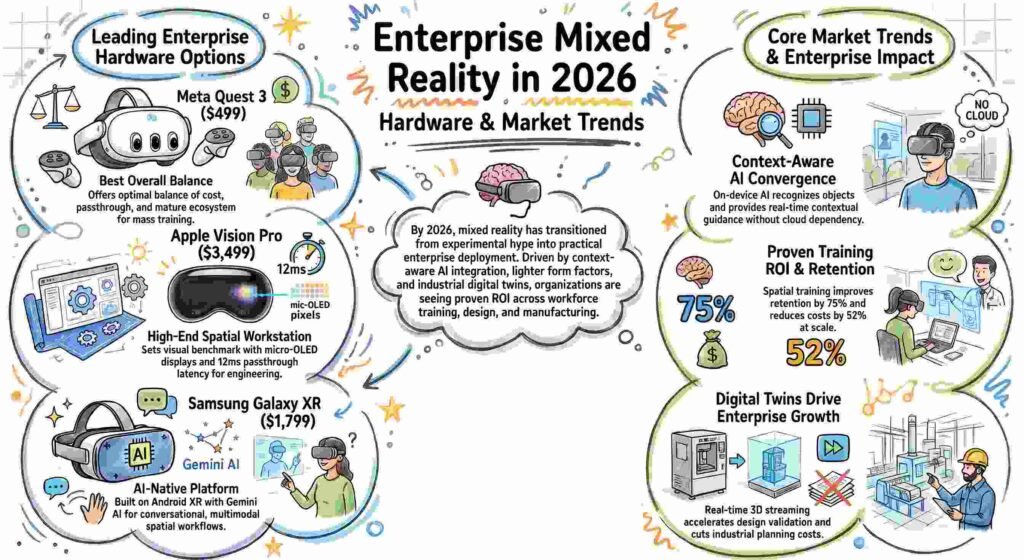
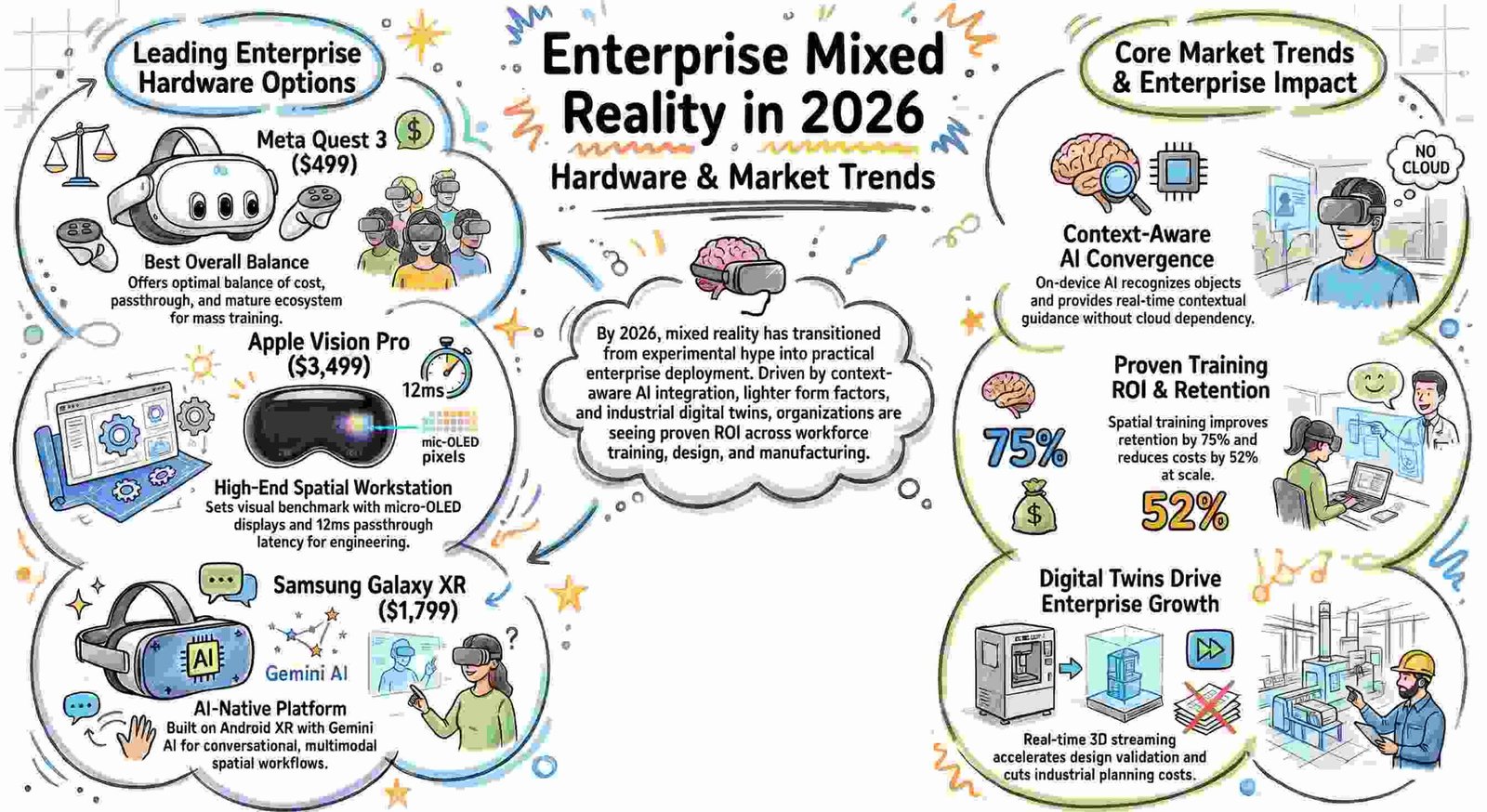
- Fleet Training & Scaled Workforce Onboarding: Entry-level standalone devices like the Meta Quest 3S (299**) and the **Meta Quest 3** (**499) utilize integrated mobile processors (Snapdragon XR2 Gen 2) to deliver optimal cost-to-performance ratios and rapid scalability for procedural learning.
- Spatial Workstations & Collaborative CAD: High-end spatial computers like the Apple Vision Pro ($3,499) leverage offloaded external battery architecture to reduce head weight while driving dual micro-OLED displays (3660×3200 per eye) with M-series processing power, creating high-fidelity environments for executive reviews and spatial engineering.
- Mission-Critical Simulation & Aerospace: Heavy-duty gear like the PC-tethered Varjo XR-4 ($3,990+) trades wireless portability for uncompromised compute offloading, delivering human-eye visual precision (51 pixels per degree in the Focal Edition, 3840 × 3744 per eye resolution) across an expansive 120° × 105° field of view required for flight simulation and defense engineering.
Aligning physical ergonomics, power profiles, and compute infrastructure with the specific cognitive load of a given environment is now the baseline requirement for enterprise spatial deployments.
2.The Silent 8-Hour Power Users vs. The “Dead Tech” Narrative
Public tech forums regularly dismiss spatial computing as a failed experiment. Online threads on sites like MacRumors feature recurring cynicism, with commentators writing off operating system updates like visionOS as minor reminders that the hardware still exists, or claiming headsets are simply “gathering dust” on shelves.
Yet, directly beneath this public cynicism operates a dedicated class of full-shift power users who have integrated spatial displays into their daily operational architecture. While consumer media continues searching for immersive VR gaming hits, business operators and system administrators leverage multi-window spatial canvases for complex digital management:
“Only about 8-10 hours a day, but besides that gathering dust! It only helps me run and manage my business and servers with a nice floating windows and interfaces that I can run anywhere.” — Forum User, MacRumors
This dichotomy highlights how consumer entertainment expectations distort market perception. While casual buyers often abandon headsets purchased for novel media consumption, knowledge workers harness spatial displays to create “zero-monitor workstations.” By tethering physical input peripherals—a keyboard and mouse—to an infinite, spatial array of virtual Mac displays, terminal windows, and server dashboards, power users have replaced multi-monitor hardware rigs with a portable, minimal physical desk footprint.
3. Static Overlays Are Dead—AI Is Turning Headsets Into Intelligent Co-Workers
Early spatial interface design suffered from static digital overlays—essentially floating 2D PDF manuals anchored in three-dimensional space. The convergence of on-device artificial intelligence with spatial sensing has fundamentally transformed headsets from passive heads-up displays into active, context-aware digital co-workers.
A fundamental architectural distinction has emerged in how platform giants approach spatial AI vision:
- Continuous Multimodal Streaming: Google and Samsung’s implementation of Gemini Live within Android XR on the Samsung Galaxy XR streams continuous, real-time video feeds to analyze dynamic physical environments fluidly.
- Gaze-Tracked Visual Snapshots: Apple’s Siri Visual Intelligence in visionOS 27 utilizes eye-tracking coordinates to snapshot a high-resolution frame of exactly where the user’s gaze fixes, analyzing context on demand without continuous video capture overhead.
Crucially, modern headsets process these spatial scene graphs using localized Neural Processing Units (NPUs) directly on the device. Local NPU execution eliminates round-trip cloud latency, guarantees real-time visual feedback, and addresses non-negotiable enterprise data privacy mandates regarding proprietary manufacturing workflows.
This AI layer turns mixed reality into an active real-time tutor on industrial factory floors:
- Automated Error Detection: If an assembly technician positions a gasket backwards, localized computer vision identifies the physical misalignment instantly, highlights the mistake visually, and presents corrective spatial guidance.
- Contextual Telemetry Queries: Technicians can point at machinery and ask natural language questions (e.g., “Why is this hydraulic pressure spiking?”), receiving instant visual overlays correlated with live IoT telemetry and CAD schematics.
4. Video Passthrough Won the Mainstream, But Optical AR Holds the Surgical Line
The architectural rivalry between Video Passthrough (cameras capturing reality and displaying it on internal screens, as seen in Meta Quest 3, Apple Vision Pro, and Samsung Galaxy XR) and Optical See-Through (projecting digital light through transparent glass, used by Magic Leap 2 and HoloLens 2) has settled into distinct operational domains.
Video passthrough captured mainstream enterprise dominance due to superior visual opacity, wider fields of view, and ultra-low camera-to-display latency (such as Apple Vision Pro’s 12ms passthrough latency). However, optical see-through remains mandatory in safety-critical environments due to fundamental physical safety parameters and ergonomic distribution.
As documented in enterprise hardware analyses, devices like the Magic Leap 2 achieve a lightweight 260g head-feel by offloading processing and battery hardware to a hip-mounted Compute Pack, whereas video passthrough headsets concentrate displays, sensors, and thermal management on the user’s face (weighing 515g to 650g+). More importantly, if a video passthrough headset suffers catastrophic power loss, the internal displays go black, instantly blinding the operator. In a surgical suite or around active industrial robotics, that sudden blindness is unacceptable. Optical see-through hardware guarantees that if system power fails, the user retains unmediated, direct natural vision of the physical environment.
| Attribute | Video Passthrough | Optical See-Through |
| Primary Architecture | External cameras stream digitized environment to internal micro-displays | Digital light projected directly onto transparent physical glass lenses |
| Latency Profile | Camera-to-display sensor pipeline (e.g., Apple’s 12ms latency) | Zero optical latency (unmediated direct physical vision) |
| Ergonomics & Mass Distribution | Front-heavy facial load (515g–650g+) containing sensors and displays | Lightweight head-feel (260g) via hip-mounted belt Compute Pack |
| Power Loss Safety Behavior | Instant display blackout (complete visual occlusion) | Failsafe pass-through (uninterrupted direct human vision) |
| Critical Use Cases | Virtual multi-monitor desks, CAD design, fleet training, immersive AI | Surgical navigation, active manufacturing plants, hazardous defense zones |
5. Hard ROI Beats Consumer Hype (Up to 90% Cost Reductions)
While public commentary focuses on smart glasses, industrial engineering and enterprise workforce operations have quietly established a massive economic baseline for spatial computing. Driven by hard operational metrics, the broader mixed reality market is expanding toward an estimated $64.87 billion by 2032 (up from $2.13 billion in 2023).
Industrial deployments across global manufacturing supply chains demonstrate verified, scalable returns:
- Aerospace Maintenance Efficiency: Boeing integrated MR-guided maintenance systems to deliver real-time data to technicians, achieving a 20% decrease in maintenance time and a 15% increase in overall operational efficiency. Airbus recorded an 80% faster design validation phase and a 30% improvement in complex assembly tasks using spatial instruction sets.
- Digital Twin & Factory Optimization: BMW’s Virtual Factory utilizes digital twin spatial layouts to conduct pre-construction collision checks, projecting up to a 30% reduction in production planning costs. Siemens’ Digital Twin Composer demonstrated a 20% throughput increase during initial deployment with PepsiCo while catching up to 90% of potential build issues before physical factory construction began.
- Electronics & Network Manufacturing: Fujitsu deployed spatial guidance for network equipment assembly, reducing assembly duration from 120 to 97 minutes (19% productivity increase), cutting SFP transceiver installation time from 53 to 31 minutes (42% improvement), and compressing operator onboarding from 3–5 days down to approximately 1 hour.
- Quantifiable Workforce Training Impact: Aggregated enterprise research confirms that spatial immersive training delivers 75% higher knowledge retention and 40% to 60% faster completion times compared to traditional classroom instruction. Trainees report feeling 275% more confident applying acquired skills, while organizations achieve up to a 90% training cost reduction at scale by minimizing physical equipment downtime and travel expenses.
Conclusion
Mixed reality in 2026 has successfully shed its overhyped consumer gaming narrative to establish a grounded, highly functional technology layer across modern industry. The convergence of localized AI vision, precise hardware-workflow matching, and verified multi-million-dollar enterprise ROI has replaced metaverse spec-building with targeted spatial tools. As spatial displays become permanent digital fixtures on minimal physical desks and intelligent assistants actively read physical workspaces, spatial computing has completed its transition from a technological novelty to essential enterprise infrastructure.
How will the integration of spatial displays and context-aware AI co-workers alter the physical spatial layout and operational architecture of your own industry over the next three years?
Discover more from TechResider Submit AI Tool
Subscribe to get the latest posts sent to your email.