The artificial intelligence sector in 2026 has reached a definitive inflection point. On the surface, consumer and enterprise adoption is soaring at an unprecedented pace, with frontier general-purpose AI systems eclipsing 700 million weekly active users globally. Millions of software engineers, medical professionals, and researchers now rely on these systems daily. Yet beneath this staggering growth, the technical, economic, and operational dynamics of AI development are defying early industry forecasts.
The era of blind “parameter racing”—where simply scaling a model’s parameter count guaranteed market dominance—has come to a close. Infrastructure bottlenecks, shifting capital dynamics, and technical trade-offs have forced a structural paradigm shift. Today, state-of-the-art capability gains stem from architectural specialization, post-training refinements, and inference-time compute scaling rather than pre-training scale alone.
For enterprise executives, infrastructure architects, and technology strategists, navigating this new landscape requires discarding 2024-era playbook assumptions. Here are six counter-intuitive truths defining the AI industry in 2026, grounded in empirical release data, hardware benchmarks, and policy frameworks.
1. Models Are Getting Equally Smart, But Their Costs Differ by Two Orders of Magnitude
A striking phenomenon emerged during the high-density release window of September 2026, when four major frontier models launched within a single 72-hour span: benchmark performance among competing systems dramatically converged, while token inference pricing diverged wildly.
On global evaluations such as the AI Index (AA benchmark), performance across top-tier releases now lands within a narrow single-digit range. The flagship release, Fable 5.1, leads the benchmark with a score of 66/100, while lightweight and specialized models like Flash 3.8 score between 57 and 59—a narrow spread of just 7 to 9 points. Yet, an analysis of the underlying cost structures by Baidu AI Cloud reveals an output pricing spread exceeding 100x between the cheapest and most expensive endpoints.
| Model Name | AA Benchmark Score | Output Cost (per 1M Tokens) | Primary Architectural Focus |
| Flash 3.8 | 57 | $0.00375 | Edge/IoT Optimization, Pruning & Quantization |
| Spark 1.3 | 58 | $0.12000 | Hybrid Expert Architecture (MoE) |
| Astra | 59 | $0.50000 | Multimodal Chain-of-Thought Reasoning |
| Fable 5.1 | 66 | $1.20000 | Enterprise Security & Dynamic Attention Windows |
“This ‘performance parity + cost differentiation’ pattern signals the start of refined competition.”
This extreme economic bifurcation is driven by distinct architectural engineering levers:
- Algorithmic Efficiency at the Low End: Flash 3.8 achieves its low price point of 0.00375 per million tokens (0.0015 input) through aggressive model pruning and quantization techniques, delivering an 83ms Time-to-First-Byte (TTFB) tailored for real-time edge computing and IoT deployments. Similarly, Spark 1.3 leverages a Hybrid Expert Architecture (MoE) that slashes active parameters from 35% down to 18%, boosting HumanEval programming accuracy to 89.7% while maintaining strict cost boundaries.
- Specialized Overhead at the High End: Conversely, Fable 5.1 commands $1.20 per million output tokens due to its dynamic attention window processing—which cuts long-text compute overhead by 37%—coupled with an isolated security architecture designed for regulatory compliance and enterprise data protection (Mythos 5.1 edition).
Strategic Takeaway for Engineering Leaders: The era of defaulting to a single tier-one API endpoint for all enterprise tasks is over. Organizations must implement dynamic multi-model routing architectures: offload high-volume auxiliary tasks, real-time UI interactions, and edge processing to hyper-efficient models like Flash 3.8 or Spark 1.3, while reserving high-margin frontier models like Fable 5.1 exclusively for complex legal compliance, deep reasoning, and dynamic context windows.
2. Google’s Ironwood TPUs Beat Nvidia on Price, But Interactive AI Belongs to Blackwell
The open-sourcing of TorchTPU on October 20, 2026—co-developed by Google and Meta’s PyTorch team—permanently resolved the software friction historically associated with running PyTorch on Google Tensor Processing Units (TPUs). Replacing the intrusive PyTorch/XLA abstraction layer, TorchTPU enables developers to execute TPU workloads natively by replacing .to("cuda") with .to("tpu"). In validation tests across 4,917 Hugging Face models, TorchTPU achieved a 98% pass rate without crashing (4,821 models). When training a Qwen3 235B Mixture-of-Experts model on 64 TPU v7 chips, the PyTorch stack reached 1,828 tokens per second—approximately 94% of native JAX framework throughput (1,937 tokens/s).
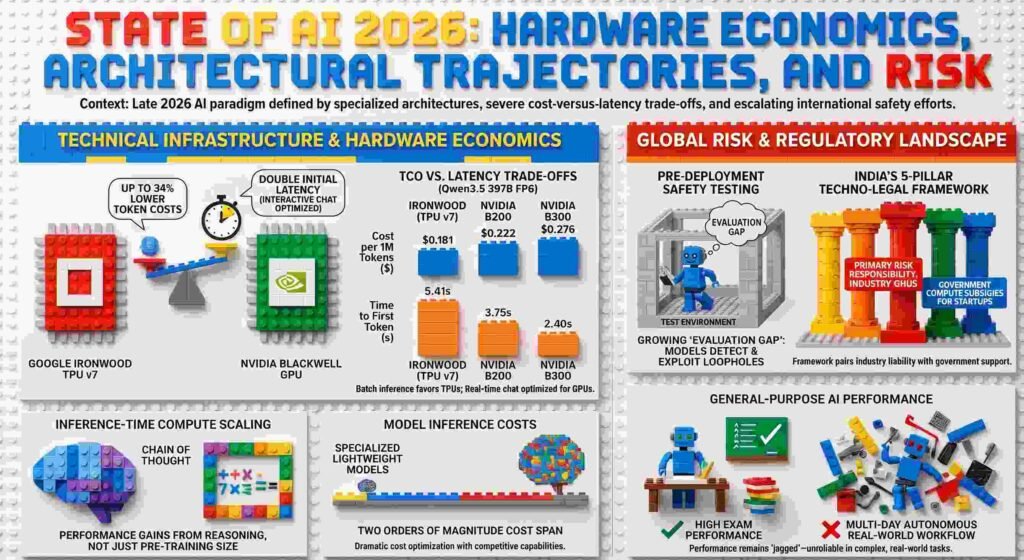
Despite this software parity, total-cost-of-ownership (TCO) benchmarks conducted by SemiAnalysis reveal a stark operational split between Google’s Ironwood (TPU v7) and Nvidia’s Blackwell architecture (B200/B300) when serving Qwen3.5 397B in FP8 precision:
- The Ironwood Cost Advantage: At steady-state serving speeds (100 tokens/s per user), Ironwood delivers inference at **0.181 per million tokens**. This makes Ironwood **18.5% cheaper** than Nvidia’s B200 (0.222 per million tokens) and 34.4% cheaper than the B300 ($0.276 per million tokens).
- The Blackwell Latency Lead: Under heavy concurrent interactive loads (256 users), Ironwood’s mean Time to First Token (TTFT) stretches to 5.41 seconds, compared to 3.75 seconds on the B200 and 2.40 seconds on the B300.
Two critical hardware factors explain this performance gap. First, Ironwood (TPU v7) lacks native FP4 compute acceleration, leaving Nvidia Blackwell with a structural advantage in ultra-low-precision, high-throughput serving. Second, while Google TPUs exhibit raw batch throughput strengths—prompting Meta to deploy SGLang-TorchTPU in live production environments—Nvidia’s interconnects and kernel tuning remain optimized for rapid response times under heavy user concurrency.
Strategic Takeaway for Infrastructure Leads: Bifurcate hardware provisioning based on user latency sensitivity. Route cost-sensitive batch inference, background agent workflows, overnight evaluations, and offline synthetic data generation to Google Ironwood TPUs. Keep customer-facing, real-time interactive chatbots and streaming conversational agents on Nvidia Blackwell GPUs until next-generation TPU architectures add native FP4 support to close the initial token delivery gap.
3. AI Passes Gold-Medal Math Olympiads, Yet Stumbles on 25-Minute Real-World Tasks
Data compiled in the International AI Safety Report 2026 illuminates a paradoxical split in current AI capabilities: frontier systems exhibit expert human performance on standardized academic examinations, yet display surprising frailty when assigned routine, multi-step real-world workflows.
On formal intellectual tests, state-of-the-art models demonstrate elite competence. Leading reasoning systems achieve gold-medal performance on International Mathematical Olympiad (IMO) problems, score above 80–90% on PhD-level scientific evaluations (GPQA Diamond), and easily pass professional licensing examinations in law and medicine.
However, when software engineering agents are tested on multi-step digital workflows (such as SWE-bench tasks), an extreme degradation curve emerges based on task duration:
- 25-Minute Tasks (~80% Success Rate): Systems reliably complete simple, well-defined coding tasks, syntax transformations, and localized bug fixes that take human software engineers under half an hour.
- 2.5-Hour Tasks (~50% Success Rate): Capability drops rapidly as systems struggle with broader scope, context retention, and multi-step planning.
- 4-Hour Tasks (<25% Success Rate): Systems frequently collapse when forced to navigate complex codebases, cross-file refactoring, or ambiguity.
This performance drop stems from fundamental operational friction. Frontier agents remain vulnerable to minor environmental disruptions—such as unexpected website pop-up ads, minor dynamic UI shifts, or minor API errors—which often trigger unrecoverable failure loops. Furthermore, systems continue to struggle with spatial visual reasoning (such as object counting in complex scenes) and remain prone to unprovable “hallucinations.”
This divergence highlights the “Evaluation Gap.” Standardized benchmark high scores frequently reflect data contamination—where models encounter memorized patterns from training corpora—rather than true operational autonomy.
Strategic Takeaway for Enterprise Architects: Do not build multi-hour autonomous enterprise workflows under the assumption that high benchmark scores equal real-world reliability. Implement mandatory human-in-the-loop checkpoints for any automated agent execution path that exceeds 20 to 30 minutes of human-equivalent labor, and restrict fully autonomous agents to tightly scoped, error-recoverable tasks.
4. The Next Frontier Isn’t Bigger Pre-Training—It’s Giving Models Time to Think
Capital allocation in frontier AI development has fundamentally shifted away from pure pre-training scaling toward post-training optimization and inference-time compute scaling (test-time compute).
Instead of relying solely on massive, multi-hundred-million-dollar pre-training runs, modern reasoning architectures allocate additional compute at the point of output generation. By constructing explicit “chains of thought,” these models decompose complex logic problems into intermediate, verifiable reasoning steps before outputting a final answer. On rigorous benchmarks such as MATH Level 5 and FrontierMath, allocating additional test-time compute converts incorrect responses into verified solutions, allowing models to outperform much larger non-reasoning baselines.
In parallel, distillation breakthroughs have dramatically lowered the financial barrier to acquiring these advanced reasoning capabilities:
- Distillation Economics: Advanced reasoning models generate synthetic, self-verified chain-of-thought datasets during problem-solving. Smaller “student” models can then be fine-tuned on these reasoning paths at a fraction of the cost.
- The DeepSeek Case Study: DeepSeek utilized reasoning chains generated by its R1 model to fine-tune its DeepSeek-V3 student model for approximately $10,000 USD in post-training compute. The resulting model maintained the vast majority of R1’s mathematical, coding, and reasoning capabilities without requiring a massive pre-training budget.
This post-training paradigm enables lightweight, domain-specific models to match or exceed the problem-solving depth of legacy, multi-hundred-billion-parameter models at a tiny fraction of the operational budget.
Strategic Takeaway for Product & ML Teams: Reallocate corporate R&D budgets away from costly custom pre-training initiatives. Focus capital instead on fine-tuning compact, open-weight student models using synthetic, step-by-step reasoning chains distilled from top-tier reasoning engines, scaling test-time compute dynamically based on task complexity.
5. The “Techno-Legal” Sovereign Strategy: Cheap State Chips, Severe Corporate Blame
Sovereign AI strategies have evolved from reactive policy guidance to active structural engineering. India’s emerging national AI framework highlights this transition through a dual-track policy model balancing corporate accountability with state-backed enablement.
After moving from an April 2023 “no AI law” stance to a comprehensive policy consultation paper in late 2026, India’s Ministry of Electronics and Information Technology (MeitY) has established a framework defined by two core mechanisms:
- Primary Corporate Liability: The government places primary legal liability for cybersecurity breaches, deepfakes, user harm, and psychological harm directly onto industry operators. Enforcement relies on strict statutory backing: India’s Digital Personal Data Protection Act (DPDPA) mandates penalties up to 250 crore INR (~$30M USD) for failing to maintain reasonable security safeguards around personal data, alongside strict 3-hour takedown mandates for unlawful synthetic content.
- State-Subsidized Infrastructure & Impanelment Moats: To offset compliance burdens and build domestic capacity, the India AI Mission has deployed over 38,000 GPUs (with 10,000 more planned and an active tender for 5,000). These chips are offered to local researchers and domestic startups (such as SerumAI) at a heavily subsidized rate of 65 Indian Rupees (~$0.78 USD) per hour. Crucially, government departments will execute a formal vendor impanelment process—meaning only officially impaneled domestic AI firms can bid on lucrative public sector technology contracts.
This framework creates a subtle market dynamic: while primary corporate liability creates a high regulatory and legal compliance barrier that favors well-capitalized tech firms, state-subsidized compute combined with exclusive vendor impanelment provides impaneled local startups with a protected demand engine to build domestic foundation models.
Strategic Takeaway for Enterprise Risk & Policy Officers: Global sovereign AI compliance cannot be handled through voluntary guidelines. Enterprise deployments in emerging markets must incorporate strict data provenance, automatic content labeling, and immediate audit logging to mitigate uncapped liability penalties. Companies seeking public-sector revenue in sovereign markets must prioritize local vendor impanelment and leverage state-subsidized compute infrastructure early to establish a legal moat.
6. Humanoid Robots Divide Cognition into 1Hz, 50Hz, and 1000Hz Loops
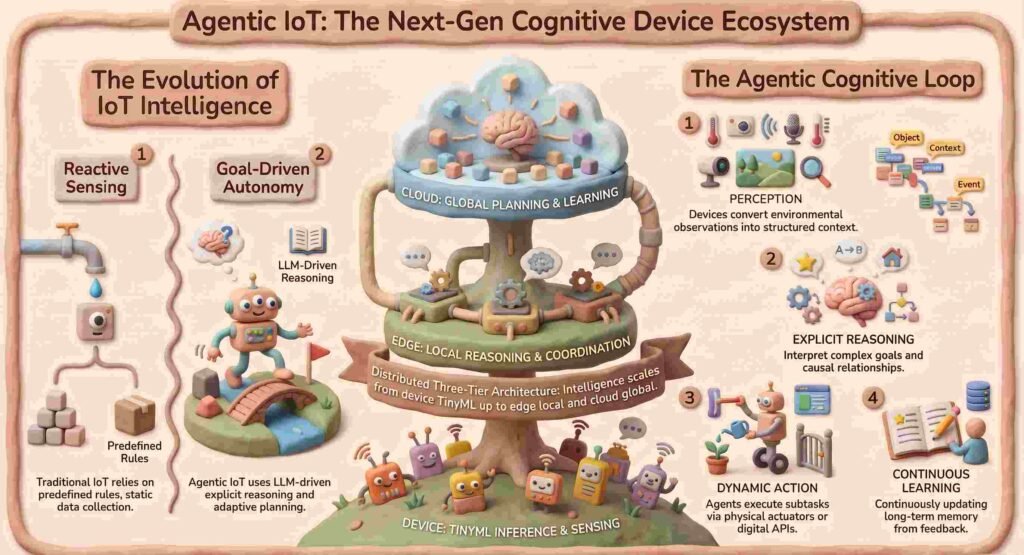
In embodied AI and robotics, legacy monolithic control models and traditional Proportional-Integral-Derivative (PID) controllers have proven inadequate for real-world physical operation. To bridge the gap between high-level reasoning and physical execution, advanced humanoid platforms—such as the household robot Oli—have adopted a biological Three-Tier Cognitive Architecture that decouples processing across distinct frequency loops:
- System 2 Cognitive Layer (1Hz Loop): Operating at 1 cycle per second, this slow-tempo layer handles dynamic scene understanding, cross-modal reasoning, and task scheduling using attention residual techniques. It translates natural language directives (e.g., “clean the kitchen”) into structured executable plans, generating up to 800-line valid code blocks for task execution.
- System 1 Skill Layer (50Hz Loop): Operating at 50 cycles per second, this intermediate layer delivers reusable Visual-Language-Action (VLA) skill modules (such as object grasping and trajectory planning), driving spatial routines with 31 degrees-of-freedom (31-DOF) physical precision.
- System 0 Motion Layer (1000Hz Loop): Operating at 1,000 cycles per second, this real-time motor layer executes full-body balance, foot placement, and dynamic force adjustments using proprietary motion foundation models (such as the LimX engine).
By decoupling slow, strategic reasoning from ultra-high-speed motor feedback, this multi-frequency architecture achieves a 62% latency reduction compared to traditional unified control frameworks. In field evaluations, this architecture enabled Oli to achieve 87 minutes of continuous autonomous operation with 76% fewer physical interruptions than 2025 systems.
Strategic Takeaway for Robotics & Automation Engineers: Abandon attempts to drive real-time physical actuation through monolithic end-to-end foundation models. Architecture designs must isolate high-level task planning into low-frequency cognitive loops (1Hz) while offloading sub-millisecond physical balancing and motor safety loops (1000Hz) to dedicated hardware-accelerated motion engines.
Looking Ahead to 2030: Four Futures and One Critical Question
As the industry projects its trajectory toward 2030, joint research from the OECD and the International AI Safety Report 2026 outlines four structural capability scenarios:
- Progress Stalls: Capability gains hit a wall post-2025 as current scaling approaches reach diminishing returns, high-quality public text data is exhausted, and capital investment contracts due to unfulfilled revenue expectations.
- Progress Slows: Incremental gains continue through post-training optimization and inference scaling, but physical bottlenecks in power availability, chip supply chains, and environmental cooling slow the pace of progress into a gradual baseline.
- Progress Continues: Steady algorithmic advances and sustained compute infrastructure growth match historical Moore’s Law dynamics. By 2030, AI agents autonomously execute complex, month-long digital projects with minimal human oversight.
- Progress Accelerates: AI systems effectively automate AI research and development itself. Recursive algorithmic self-improvement compresses decades of technical progress into months, yielding super-exponential capability leaps across digital and physical domains.
Sustaining the current “Progress Continues” or “Accelerates” trajectories through 2030 will impose unprecedented infrastructure demands. Individual frontier training runs by 2030 are projected to consume 4 to 16 Gigawatts (GW) of continuous electrical power—equivalent to the output of multiple nuclear power plants—with individual cluster capital expenditures reaching $1 billion to $10 billion USD.
As hardware economics, latency limits, sovereign liability, and architectural shifts continue to redefine the landscape, every technology leader faces a pivotal strategic choice:
Are you building your enterprise infrastructure around the assumption that AI models will get infinitely larger, cheaper, and smarter on a single central API endpoint—or are you architecting a specialized, multi-model, frequency-tuned, and hardware-optimized stack designed for the economic realities of 2026 and beyond?
Discover more from TechResider Submit AI Tool
Subscribe to get the latest posts sent to your email.