1. Introduction
For over a decade, a single tech giant comfortably held the global crown in mobile sales through sheer shipment volume. However, a major plot twist recently reordered the entire industry landscape when global smartphone leadership flipped.

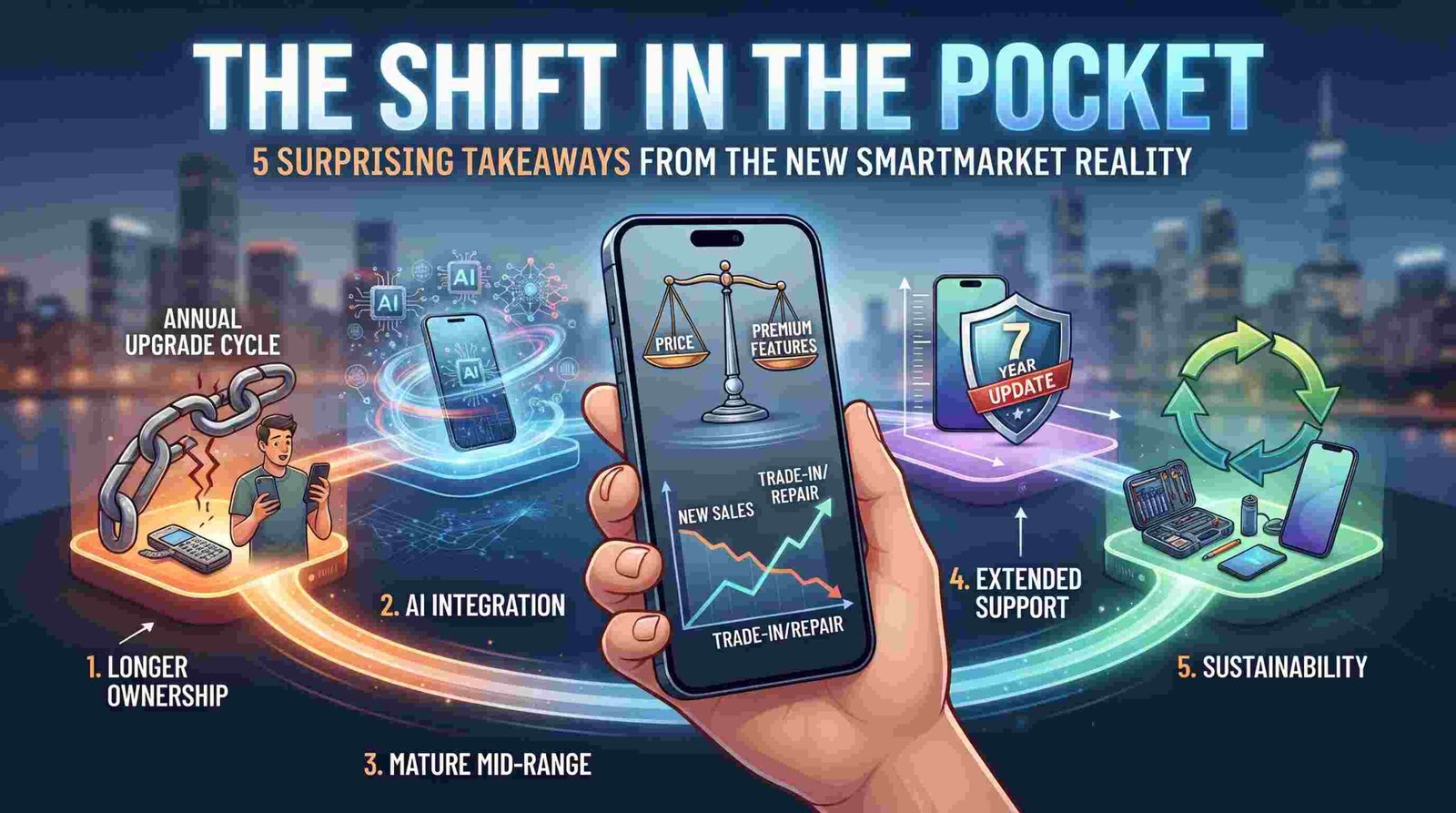
In 2025, Apple officially captured the top spot in annual global smartphone sales. Beyond a simple sales victory, this shift represents a fundamental transition from a volume-driven smartphone market to a margin- and retention-driven ecosystem where consumers prioritize premium hardware, extended support, and long-term value.
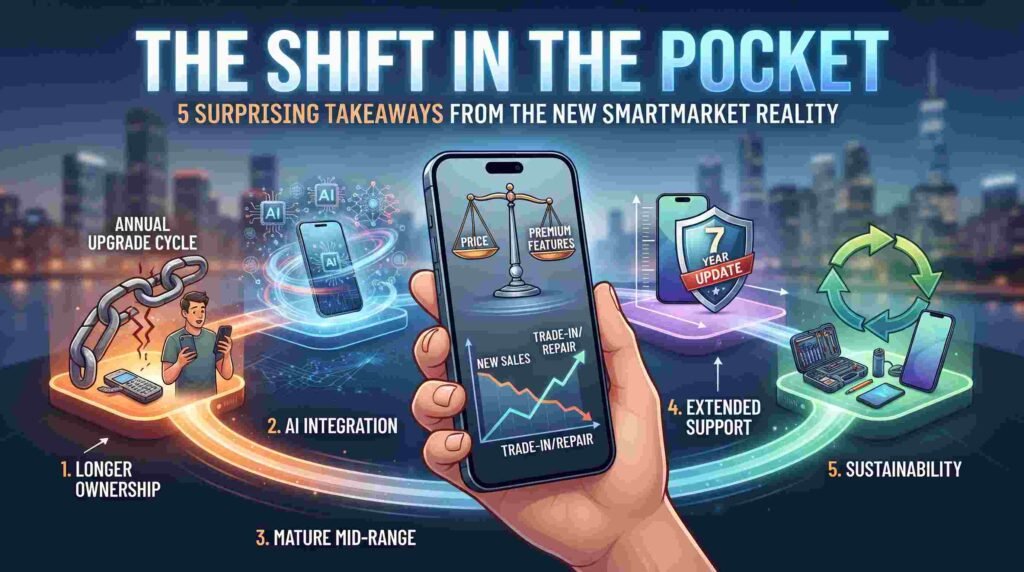
Understanding this new dynamic requires looking closely at the data and strategic moves shaping the industry. Here is a scan-friendly breakdown of the five most surprising takeaways driving this new mobile reality.
2. Apple’s 14-Year Wait Is Over—Winning with Premium Power
Apple’s ascent to the top of annual smartphone sales marks a historic milestone. The company dethroned Samsung in annual figures for the first time in 14 years, ending a competitive streak that had stood firmly since 2011.
In 2025, Apple captured 20% (one-fifth) of total worldwide smartphone sales, edging out Samsung’s 19% market share and Xiaomi’s 13%. Apple posted a 10% year-over-year (YoY) annual growth rate, making it the only brand within the top six market cluster to achieve double-digit annual shipment growth.
Samsung historically secured its lead through sheer volume driven by budget-centric devices like the Galaxy A-series. Conversely, Apple conquered the overall market by dominating the high-margin premium segment, proving consumer behavior is gravitating toward premium flagships despite broader macroeconomic friction.
“The iPhone 17 series gained significant traction in Q4 following its successful launch, while the iPhone 16 continued to perform exceptionally well in Japan, India and Southeast Asia.”
3. A Massive Product Flop Couldn’t Stop Apple’s Record Momentum
Apple achieved record-setting shipment numbers through a strikingly counter-intuitive dynamic: it posted historic volume despite one of its key new models flopping. According to reports from Nikkei Asia, the ultra-thin iPhone Air experienced underwhelming initial demand, prompting Apple to slash its production plans.
Crucially, Apple pivoted by reallocating its supply chain capacity directly to boost production of standard and Pro iPhone 17 models. This strategic operational shift enabled market research firm IDC to forecast record shipments of 247.4 million iPhones in 2025, powered by phenomenal demand across the rest of the portfolio.
The standard iPhone 17 emerged as a sleeper hit value proposition, offering a 120Hz OLED screen, significantly extended battery life, sensor camera upgrades, a durable build, and faster charging. Meanwhile, the iPhone 17 Pro duo introduced a completely redesigned aesthetic, Apple’s first-ever vapor chamber cooling system, a brighter display, and an upgraded 48MP telephoto camera capable of 8x optical zoom.
“This is the phone you should buy despite the company offering two other very compelling offerings.”
4. Budget Phones Are Stealing Flagship AI and 6-Year Lifespans
While premium devices captured top sales headlines, entry-level and mid-tier Android hardware underwent its own quiet revolution to match lengthening consumer upgrade cycles. Samsung’s Galaxy A series captured up to five spots on global top-10 best-seller lists, leveraging a targeted strategy tailored to distinct regional markets.
In emerging markets like Latin America and the Middle East and Africa, affordable 4G LTE devices like the Galaxy A06 and A07 driven by pure utility continued to generate substantial volume. In mature markets, 5G mid-tier models like the Galaxy A36 and A56 gained momentum by infusing “Awesome Intelligence”—bringing flagship AI tools like “Nightography” and “Best Face” down to accessible price points.
Most notably, every Galaxy A-series phone appearing in the top-ten best-seller rankings now guarantees six years or more of software and security updates. Budget buyers no longer accept disposable hardware; they demand long-term support alongside advanced software capabilities.
5. The Hidden Tech Crisis—Memory Shortages Are Crushing Budget Brands
This growing push toward feature-packed, durable budget devices collided directly with severe macroeconomic supply-chain shocks. Deepening RAM chip shortages and component inflation in 2026 forced manufacturers to narrow their product portfolios to high-value models, resulting in a 7% YoY global market contraction in Q2 2026.
Budget-reliant manufacturers bore the brunt of this component crisis. Xiaomi suffered the steepest drop among top brands, falling 26% YoY in Q2 2026 because its heavy exposure to price-sensitive entry- and mid-tier segments forced repeated retail price increases, suppressing affordability across emerging markets.
In contrast, developed regions like North America actually grew 6% YoY in Q2 2026, supported by carrier financing and premium margin buffers that absorbed component inflation. Apple leveraged this regional resilience, remaining the only major OEM to avoid retail price hikes while recording 13% YoY growth due to its supply chain influence and strong margin buffers.
6. Ultra-Premium Flagships Rule Android, While Challenger Brands Surge
The Android ecosystem is undergoing its own unexpected structural transformation. Highest-end flagships are taking over sell-through best-seller charts, while nimble challenger brands post explosive shipment growth percentages by targeting distinct hardware niches.
In Q2 2026, the Samsung Galaxy S26 Ultra claimed the top spot as the world’s best-selling Android smartphone. This marked the first time an ultra-premium device led Android sales in a June quarter, confirming that Android consumers are increasingly willing to pay for top-tier performance over basic functionality.
Simultaneously, smaller challenger OEMs recorded massive shipment surges by carving out high-value product positions:
- Google Pixel: Achieved market-leading 35% YoY shipment growth in Q3 2025, driven by AI-led software differentiation on the Pixel 9 series and expanded carrier partnerships.
- HONOR: Registered 31% to 33% YoY shipment growth across recent quarters (including 33% in Q3 2025 and 31% in Q1 2026), propelled by strong international demand for its ultra-thin foldable Magic V2 series and aggressive expansion across Europe, APAC, and MEA.
7. Conclusion & Looking Ahead
The global smartphone market has definitively entered a mature era defined by long-term value, premium hardware, and supply chain resilience over pure shipment volume. Manufacturers relying on thick profit margins and multi-year software commitments are thriving, while consumers are keeping their handsets longer than ever before.
As budget phones adopt six-year software lifespans and flagships double down on cutting-edge AI capabilities, consumer upgrade habits face a fascinating turning point. Do you plan to hold onto your next phone for six full years, or will the next wave of flagship AI features entice you to upgrade sooner than planned?
Discover more from TechResider Submit AI Tool
Subscribe to get the latest posts sent to your email.