For over a decade, enterprise IT strategy was anchored to an unquestioned dogma: “Cloud-First.” But in 2026, structural cracks in centralized Software-as-a-Service (SaaS) models have widened into structural chasms. Technology leaders across every sector are confronting the operational friction of “SaaS Fatigue”—skyrocketing cloud API bills, escalating data egress fees, recurring hyperscaler outages, and millisecond latency delays that actively stall enterprise AI execution.
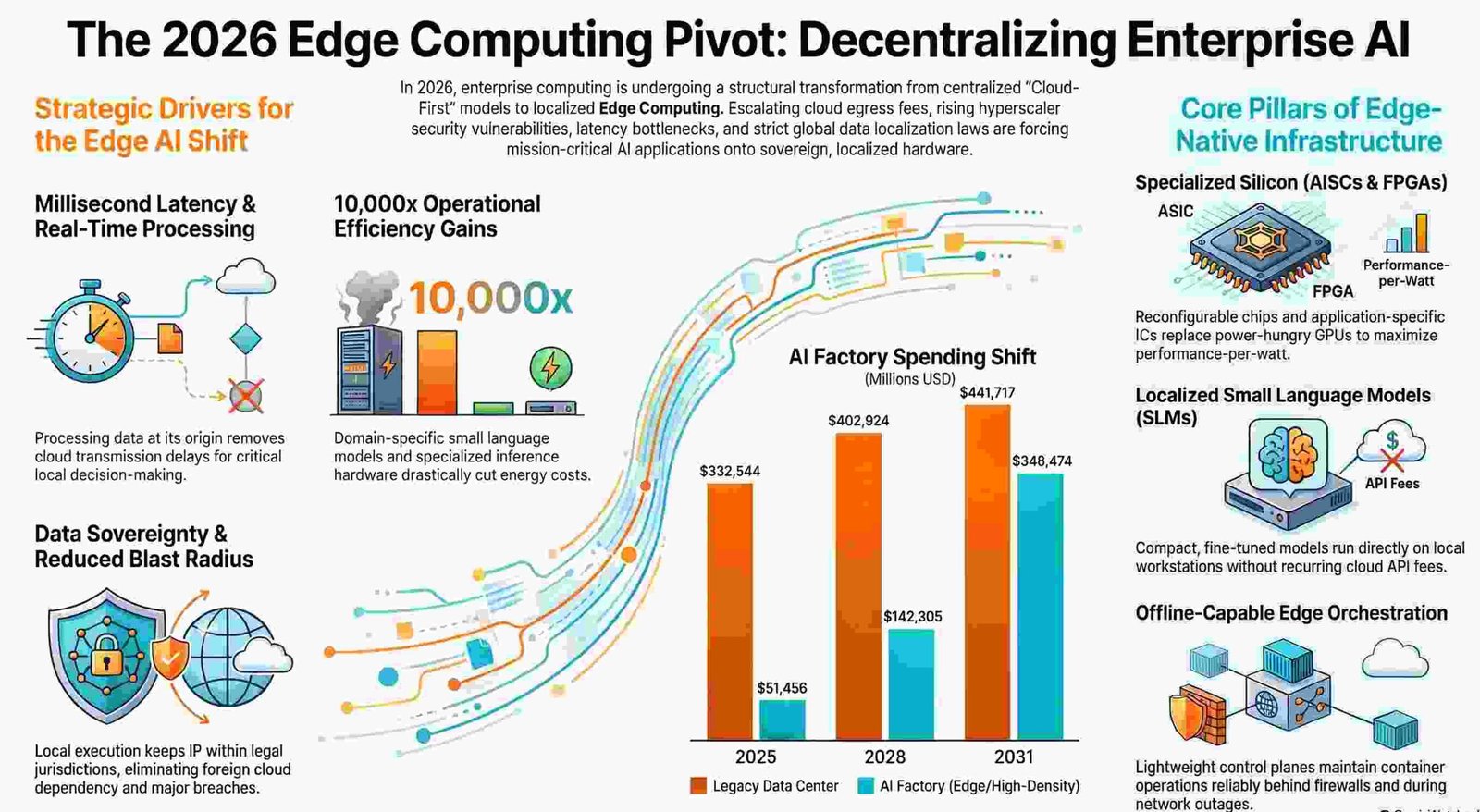
As centralized cloud monopolies strain under network congestion, heavy multi-tenancy overhead, and legacy architectural limitations, corporate computing is undergoing a fundamental restructuring. Centralized models that once promised ultimate operational simplicity now introduce unacceptable performance bottlenecks, financial volatility, and systemic security risks.
The year 2026 marks the definitive tipping point. High-density, localized computing power is shifting intelligence away from distant public cloud data centers and back to the network edge—replacing brittle centralized control with resilient, distributed autonomy.
1. SaaS Fatigue Is Real: The Cloud Has Become a Single Point of Failure
A decade of uncritical hyperscaler lock-in has transformed cloud convenience into an existential operational risk. Reliance on a tiny group of centralized public cloud providers—once heralded as the pinnacle of IT efficiency—is reaching its physical and financial limit. Millisecond-dependent applications are consistently throttled by network congestion and geographic distance, forcing enterprises to channel millions into hyperscaler infrastructures only to suffer lackluster, latency-impaired performance. Worse, recurring cloud outages repeatedly freeze corporate operations, proving that multi-tenant public clouds have become single points of failure for the modern enterprise.
Beyond latency and uptime vulnerabilities, security risks in centralized environments have magnified. The weaponization of autonomous, agentic AI has turned massive public cloud data repositories into target-rich environments for cyber adversaries. Transmitting sensitive corporate intellectual property and real-time telemetry across public networks 24/7 creates wide windows for interception. Furthermore, processing mission-critical workloads on foreign hyperscalers exposes organizations to foreign legal jurisdictions, data surveillance, and regulatory non-compliance. Passive reliance on third-party cloud boundaries actively threatens digital autonomy and corporate crown jewels.
“The centralized control model of yesterday is no longer; Edge Computing now offers a model of distributed autonomy.”
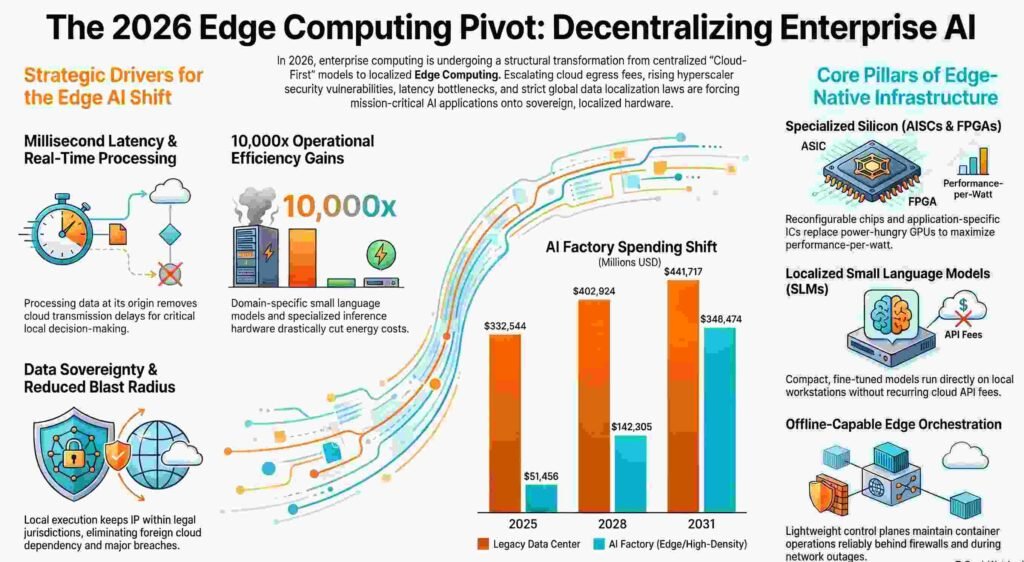
2. “Inference Economics” & Tiny Silicon Are Delivering 10,000x Efficiency Gains
As enterprise AI transitions from intensive model training to day-to-day execution, the market has pivoted toward “inference economics.” By 2026, inference accounts for two-thirds of all AI compute power. Running continuous, high-frequency AI queries through public cloud APIs exposes enterprises to unsustainable cost-per-task dynamics and severe power bottlenecks. Training a single massive model can consume gigawatt-hours of electricity—equivalent to the annual power consumption of thousands of homes. As power grids stall under these demands, optimizing performance-per-watt requires moving processing closer to the data source using specialized, low-power hardware:
- AISCs (AI-Specific Integrated Circuits): Specialized semiconductors, including ASICs and custom TPUs, designed exclusively for AI execution. By stripping out the non-essential hardware overhead required by general-purpose CPUs and GPUs, AISCs dramatically reduce energy consumption and cooling requirements, allowing production AI to scale affordably.
- FPGAs (Field Programmable Gate Arrays): Re-programmable silicon chips that deliver deterministic low latency and extreme power efficiency. Unlike fixed-function GPUs, FPGAs can be reconfigured post-deployment to adapt to evolving deep learning algorithms, providing long-term cost flexibility and operational adaptability at the edge.
- Google TPU v8 Dual-Processor Architecture: Google’s eighth-generation TPU series splits training and inference into specialized silicon—pairing the TPU 8t for massive-scale training with the TPU 8i for high-efficiency inference. Featuring expanded on-chip SRAM to host massive memory caches directly on the die, the TPU 8i bypasses the traditional processor “memory wall,” delivering up to 10,000x operational efficiency gains over legacy GPU clusters.
- DSLMs and TinyML: The industry is moving away from monolithic, one-size-fits-all models toward Domain-Specific Language Models (DSLMs) and hyper-efficient frameworks like Google Gemma 4. Designed specifically for localized execution, Gemma 4 enables full multi-agent AI architectures to run natively on standard employee workstations and Mac Minis—eliminating recurring cloud API fees and keeping proprietary intellectual property on-device.
3. Data Sovereignty Is No Longer a Legal Checkbox—It’s Architectural Defense
Fragmented global privacy regulations—such as the EU’s GDPR and strict data localization mandates across the APAC region—have converted “borderless” cloud processing into an acute legal liability. Localized edge computing redefines data protection by processing data strictly at its point of origin, shrinking the breach “blast radius” and keeping raw information within local physical and legal perimeters:
- Government & Defense: Defense units operating in zero-connectivity or contested environments cannot rely on fragile cloud links or shared foreign hyperscalers. Ruggedized, small-form-factor edge units provide tactical personnel with sovereign AI capabilities under direct national command. Systems leverage commander AI assistants that process machine-speed intelligence, enable real-time agentic defense against automated drone swarms and cyberattacks, and execute predictive analysis of troop and object movements via platforms like Palantir Gotham.
- Healthcare: Stringent privacy frameworks make centralized transmission of patient records an unacceptable security risk. Edge processing enables real-time patient monitoring, predictive event identification in remote facilities, and intelligent staff call recordings within hospital walls—allowing administrators to analyze clinical conversations and improve care outcomes without exposing raw medical data to central cloud interception.
- Financial Services: Financial institutions face strict localization mandates alongside sub-millisecond execution demands. Local edge architectures handle high-volume transaction feeds locally, running microsecond real-time fraud detection and automated trading analysis while insulating core financial workflows from catastrophic cloud outages.
4. The Edge Now Crushes Cloud in 3 Critical Real-World Scenarios
While centralized public clouds remain useful for long-term data archiving and heavy model training, edge architectures far outperform centralized clouds in real-time operational environments:
- Organizational Meetings Intelligence: Enterprise conversations contain vast amounts of valuable IP daily. Dedicated edge appliances—such as AudioCodes Meeting Insights On-Prem—process high-volume internal voice streams locally, adapting to custom corporate terminology to generate instant real-time transcriptions, action items, and conversational insights without transferring voice data off-premises. Complementary solutions like AudioCodes VoiceAI Connect seamlessly bridge telephony channels and bot frameworks across contact centers while maintaining total data confinement.
- Field Operations in Zero-Connectivity Zones: Field service technicians, first responders, law enforcement, and rural medics frequently operate in environments degraded by weather, remote geography, or power grid failures. Grounded in reference architectures like those defined by Carnegie Mellon’s Software Engineering Institute (SEI), edge systems perform local pre-processing and data filtering directly on handheld devices. By selectively filtering data before transmitting summaries to the cloud, edge devices optimize scarce network bandwidth, run localized diagnostic AI agents, and guarantee full operational uptime during total cloud disconnection.
- Mission-Critical Industrial Automation: Industrial manufacturing leverages vertical AI and computer vision to manage complex robotics and automated welding. Unlike legacy machinery restricted to fixed programming, edge equipment utilizes predictive world models to safely navigate unstructured shop floors. Sub-millisecond sensor feedback loops execute locally without network latency, instantly flagging hazards and making immediate safety adjustments to prevent industrial downtime.
5. The Infrastructure Shift: From Cloud Multi-Tenancy to “AI Factories” and Edge Orchestration
The macroeconomic migration away from multi-tenant public clouds is reflected in global capital expenditure trends. Market research indicates that the edge computing market will expand from $21.4 billion in 2025 to $28.5 billion in 2026 (a 28% CAGR). Simultaneously, total data center spending is undergoing a massive structural capital pivot away from legacy infrastructure and toward localized “AI Factories.”
| Spending Category ($ Millions) | 2025 | 2026 | 2031 |
| Legacy Data Center Spending | $332,544 | $353,779 | $441,717 |
| AI Factory Spending | $51,456 | $72,461 | $348,474 |
| Total Data Center Spending | $384,000 | $426,240 | $790,191 |
While legacy data center spending plateaus, investment in high-density AI Factories—purpose-built with liquid cooling, specialized NPU/GPU clusters, and co-located renewable energy sources (solar, wind, geothermal) to solve power grid bottlenecks—is surging. To manage containerized workloads across this distributed fleet, platform engineering teams rely on lightweight orchestration platforms supporting Docker, Kubernetes, Swarm, and Podman.
| Platform | Target Audience | Primary Edge Strength |
| Portainer | Enterprise platform, DevOps, and industrial edge teams | Centralized multi-runtime container management (Docker, Kubernetes, Podman, Swarm) with an Edge Agent that queues deployment jobs during network offline periods. |
| Azure IoT Edge | Azure-first enterprises running edge AI and analytics | Deep Azure service integration, modular workload deployment, and automatic cloud syncing via digital device twins. |
| SUSE Edge | Telecom operators, industrial managers, and regulated enterprises | Hardened, full-stack enterprise Kubernetes optimized for constrained edge environments using GitOps-driven lifecycle automation. |
| AWS IoT Greengrass | AWS-centric organizations operating large device fleets | Local execution of AWS Lambda functions and containerized workloads without requiring continuous AWS cloud connectivity. |
| Google Distributed Cloud Edge | Telecom operators (5G/MEC) and latency-sensitive industries | Fully managed Kubernetes running on localized edge infrastructure using standard Google Kubernetes Engine (GKE) APIs. |
Is Your Cloud Strategy Becoming Your Biggest Liability?
The era of blind “Cloud-First” adoption has officially drawn to a close. While centralized public clouds will continue to support massive data storage and broad model pre-training, relying on multi-tenant SaaS for real-time operational AI introduces severe financial volatility, power constraints, unacceptable latency, and acute security risks.
Navigating this edge transition requires immediate strategic realignment. Enterprise technology leaders must audit their existing AI “cost-to-value” and “power-to-token” ratios, upgrade local hardware fleets with specialized Neural Processing Units (NPUs) and AI accelerators, and deploy zero-trust security controls across distributed endpoints. Prioritizing architectural data sovereignty over cloud convenience is no longer an optional compliance preference—it is the core prerequisite for building resilient, future-proof enterprise software architectures.
As your organization scales its AI execution for the next decade, one question demands an answer: Is your cloud strategy accelerating your competitive advantage, or is it silently becoming your single biggest financial and operational liability?
Discover more from TechResider Submit AI Tool
Subscribe to get the latest posts sent to your email.