1. Introduction
For modern professionals and business leaders, the contemporary enterprise technology ecosystem presents a striking paradox. Millions of dollars are continuously poured into artificial intelligence initiatives, yet the daily operational reality inside most organizations remains defined by integration bottlenecks, fragmented pilots, and stalled momentum.
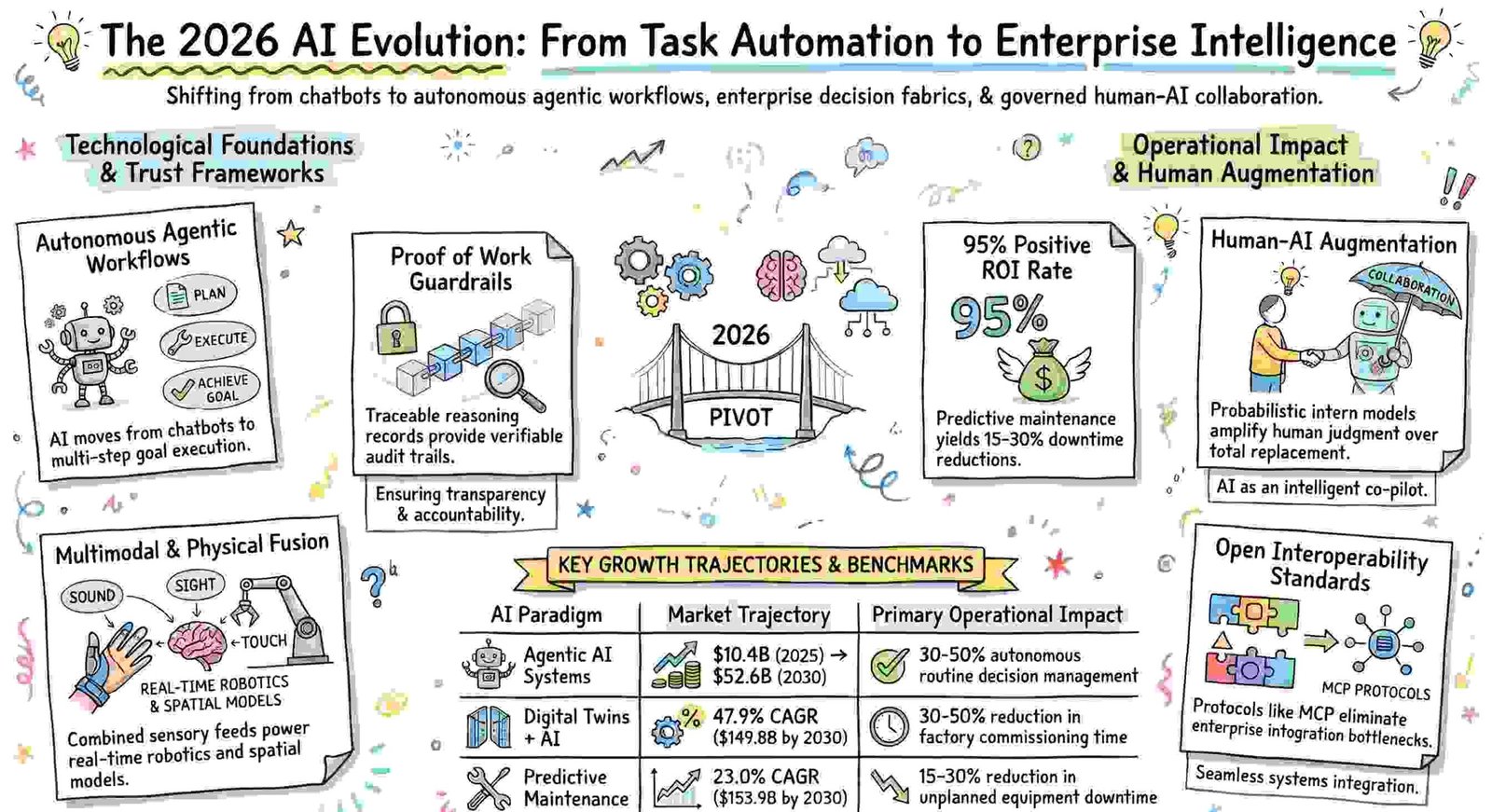
Executive ambition has routinely outpaced architectural execution. According to research from S&P Global Market Intelligence, 46 percent of AI proof-of-concepts were scrapped before deployment last year, exposing a costly divide between generative experimentation and production-grade software delivery.
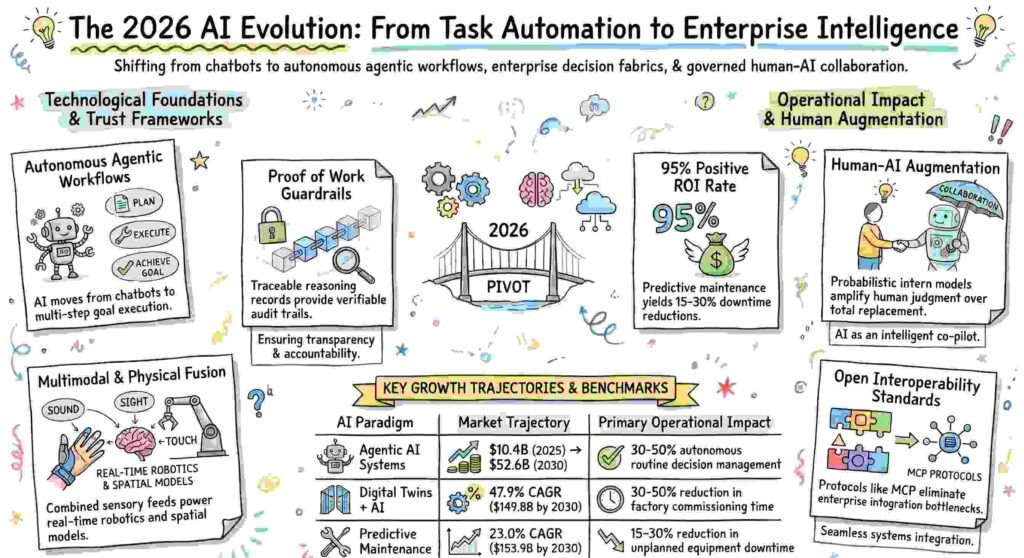
However, 2026 represents a decisive turning point. Forward-thinking enterprises are abandoning disconnected chatbots and isolated point solutions in favor of unified “decision fabrics”—architectural frameworks where autonomous agents, clean data planes, and human oversight converge to yield measurable ROI. What follows are the seven key breakthroughs defining this new era of scalable enterprise automation.
2. The “Proof of Work” Paradigm Shift: Why Verifiable Artifacts Are Replacing Resumes and Opaque AI Outputs
The concept of “Proof of Work” has emerged as a vital trust currency across both human capital and enterprise AI governance. This dual emergence stems directly from the collapse of traditional resume claims and black-box credibility in an AI-saturated market. On the talent side, platforms like Fueler have spearheaded a migration away from static credentials and unverified CV claims. Modern engineering and product teams now demand applied portfolio artifacts—executable code, documented logic trails, and real-world system designs—to validate capability instantly.
This exact paradigm has naturally extended into enterprise AI architecture. As autonomous agents transition from drafting copy to executing high-stakes financial, legal, and operational actions, opaque model outputs are no longer viable. Organizations require machine- and human-readable logs of reasoning, data inputs, tool calls, and step-by-step logic before any action is approved or written to systems of record. In both talent acquisition and enterprise software, static claims are obsolete; only verifiable execution logs carry weight.
“Proof of work refers to the human- and agent-interpretable, verifiable representation of what an AI system did and why.” — Fraser Kelton, Spark Capital
3. The Rise of Autonomous “AI Scientists”: From Generative Text to Closed-Loop Research Cycles
Enterprise automation has made a structural leap from reactive assistance to closed-loop autonomy with the emergence of “AI Scientists.” Rather than waiting for human prompts, these specialized agentic architectures execute end-to-end research and operational cycles without continuous oversight. In chemistry, these systems autonomously parse data patterns, formulate hypotheses, design virtual experiments, and propose novel battery materials in weeks rather than years; in theoretical physics, they model complex quantum entanglement applications to accelerate basic discovery.
This technical shift from prompt-driven generation to self-directed task orchestration is catalyzing massive market growth. Industry projections from Kearney indicate that the global agentic AI market will expand from $10.41 billion in 2025 to $52.6 billion by 2030, representing a 45 percent compound annual growth rate as enterprises automate multi-step workflows.
“As enterprise-grade agentic AI platforms mature, we’re seeing work itself being rewired. Core processes are shifting from linear, role-based workflows to dynamic, event-driven systems where AI agents handle routine decisions and humans step in for judgment, orchestration, and cross-functional problem solving. The real opportunity isn’t just efficiency gains, but flatter organizations, more ‘liquid’ talent models, and AI that continuously upskills every employee as they work. Agentic platforms will also act as continuous learning companions, raising the pace at which employees acquire new skills. The net effect is a fundamental rewiring of how work gets done and how organizations are designed.” — Brent Smolinski, Kearney Partner
4. The Death of the SaaS Dashboard: Why Enterprise UI is Shifting to Natural Language Intermediaries
The traditional software-as-a-service (SaaS) paradigm—where human operators manually navigate complex application interfaces, navigate menus, and transfer data between isolated software silos—is reaching its operational limit. In its place, an intermediary agentic layer has taken hold: human employees express goals through natural language, and autonomous AI agents navigate underlying software environments, execute API calls, and consolidate results.
- Traditional Software Interaction: Employee \rightarrow Direct Manual Interface Navigation \rightarrow CRM / ERP / Database \rightarrow Manual Data Extraction \rightarrow Static Report
- Agentic Workflow Execution: Employee \rightarrow Natural Language Intent \rightarrow Autonomous AI Agent \rightarrow Multi-System API Orchestration (CRM, ERP, Database) \rightarrow Completed Action & Integrated Output
This structural migration is reflected in the market momentum for Industrial Copilots and AI Assistants, which recorded explosive 150% YoY growth (expanding from $5 billion in 2024 to $13 billion in 2025). A prime enterprise deployment is Zayo’s DashAI assistant, embedded into its DynamicLink network operations. Rather than forcing network engineers to manually navigate legacy consoles, DashAI leverages Retrieval-Augmented Generation (RAG) to allow teams to provision, scale, and manage complex network infrastructure through conversational interface prompts while explicitly verifying user intent prior to execution.
5. The Data Quality Bottleneck: Why Poor Enterprise Data Freezes Multi-Step Agentic Workflows
As multi-step AI agents take on longer, more complex workplace tasks, engineering teams are confronting an unyielding reality: Better AI cannot compensate indefinitely for poor organizational data. When an autonomous agent attempts to execute an end-to-end task—such as an automated inventory replenishment agent attempting to reconcile stock across multiple facilities—it quickly freezes or hallucinates if fed contradictory ERP entries, outdated CRM permissions, or unindexed support data. Unstructured data silos and conflicting permissions inevitably break multi-step agent reasoning chains.
To overcome these technical friction points, production-grade AI deployments are now anchored by a strict, bolded 3-step data readiness framework:
- 1. Data Governance: Establish clean, lineage-tracked data products across structured and unstructured content silos, ensuring agents query accurate, real-time, and standardized enterprise context.
- 2. Least-Privilege APIs: Enforce granular access permissions and clear execution boundaries at the infrastructure level, dictating precisely which records an agent can read, write, or modify.
- 3. Unified Visibility: Implement centralized observability layers to log agent queries, monitor for model drift, and track cross-application tool execution in real time.
6. Open Standards and Local Edge Silicon: How MCP and Hardware Break the Cloud Latency Barrier
Two critical infrastructure advances are resolving the integration overhead and cloud latency challenges that previously stalled enterprise adoption: open protocol standards and specialized edge hardware.
The universal adoption of open standards like the Model Context Protocol (MCP) eliminates the need for expensive, custom point-to-point software integrations between agents and internal tools. Concurrently, powerful edge workstations—such as the HP ZGX Nano G1n, capable of running models up to 200 billion parameters locally—allow organizations to execute complex inference directly where data resides, drastically reducing cloud bandwidth overhead and keeping sensitive data safely on-premise.
- 60% to 80% Reduction in manual exception handling work for enterprise resource planning (ERP) systems achieved via standardized agent protocols like MCP.
- 100ms to 200ms Latency delivered by hybrid edge-cloud architectures, compared to the 500ms to 1,000ms latency standard in pure cloud deployments.
- 20% to 60% Productivity Gains documented across early enterprise adopters utilizing interoperable multi-agent workflows.
- 30% Reduction in operational costs projected by 2029 as agentic systems autonomously resolve roughly 80% of routine customer service and service desk interactions.
7. Autonomous Cyber Defense: The Shift from “Detect and Notify” to Machine-Speed “Detect and Resolve”
Because modern AI-driven cyber threats operate at machine speed, traditional Security Operations Centers (SOCs) relying on manual triage can no longer maintain effective perimeter controls. Consequently, cybersecurity architecture has evolved from passive alert notification to autonomous detection and resolution platforms.
Platforms such as Palo Alto Networks Cortex Cloud 2.0 and its autonomous Cortex AgentiX workforce leverage specialized agents trained on over 1.2 billion real-world threat responses to investigate alerts, map blast radiuses, and execute containment procedures within minutes. Security teams are scaling these workloads using Zscaler‘s zero-trust proxy architecture, which processes over 500 billion daily transactions to continuously block anomalies, while platforms like Cyera AI Security Platform apply the Cyera MCP and AI Guardian layer to maintain real-time guardrails, prevent data leaks into public models, and preserve data lineage.
To govern these autonomous capabilities, administrative management tools like ServiceNow’s AI Control Tower serve as active execution layers. They establish a single source of truth across cloud and on-premise assets, eliminate unsanctioned “shadow AI,” and enforce strict security boundaries dynamically across the enterprise.
8. Prescriptive Industrial Automation: Unlocking Verified, Multibillion-Dollar ROI
Industrial, manufacturing, and telecommunications environments have migrated from predictive analytics (“forecasting when a machine will fail”) to prescriptive automation (“prescribing actions, ordering replacement parts, and scheduling technicians automatically”). This transition is driving some of the highest verified financial returns in the enterprise software sector.
Predictive and prescriptive maintenance programs currently report a 95% positive ROI benchmark, with 27 percent of deployments achieving full capital payback within 12 months while cutting unplanned operational downtime by 15 to 30 percent.
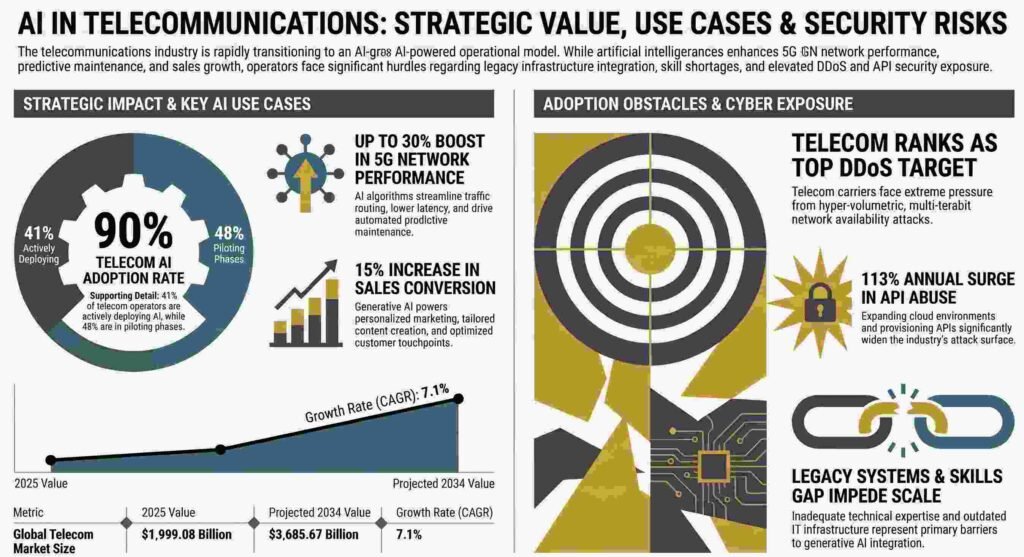
The financial scale of these operational deployments is substantial. Telecommunications giant Deutsche Telekom announced targets to capture €2.5 billion in indirect cost savings by 2030 by embedding intelligent automation across network management, early peak-traffic detection, and automated customer service troubleshooting.
9. Conclusion & Forward-Looking Thought
The phase of unfocused AI experimentation is officially behind us. As the enterprise ecosystem matures through 2026, market leadership belongs not to the organizations that deploy the largest volume of disjointed models, but to those that successfully integrate autonomous agents, clean enterprise data, and active governance into a unified decision fabric.
By standardizing workflows on open protocols, enforcing least-privilege security boundaries, and validating every autonomous action through audit-ready “proof of work” records, business leaders can finally bridge the gap between AI ambition and sustainable, bottom-line ROI.
Is your organization building a verifiable “Proof of Work” architecture for its autonomous agents, or are you still relying on unmonitored black boxes and fragile software silos?
Discover more from TechResider Submit AI Tool
Subscribe to get the latest posts sent to your email.